Average Grades
View the sheet


Silver comes in several types, each with its own distinct characteristics. 925 Sterling Silver is most widely used in jewelry for its strength and ease of working, while 950 Silver is purer but less common. For economical options, Silver Filled offers superior durability to silver plating, which is less resistant and can have a very thin layer.
Like gold, silver belongs to the family of precious metals.Solid silver refers to the silver used to make silver jewelry, which distinguishes it from silver plating, regardless of the thickness or galvanizing technique employed.
As with gold, silver can be recycled and used again to make jewelry.
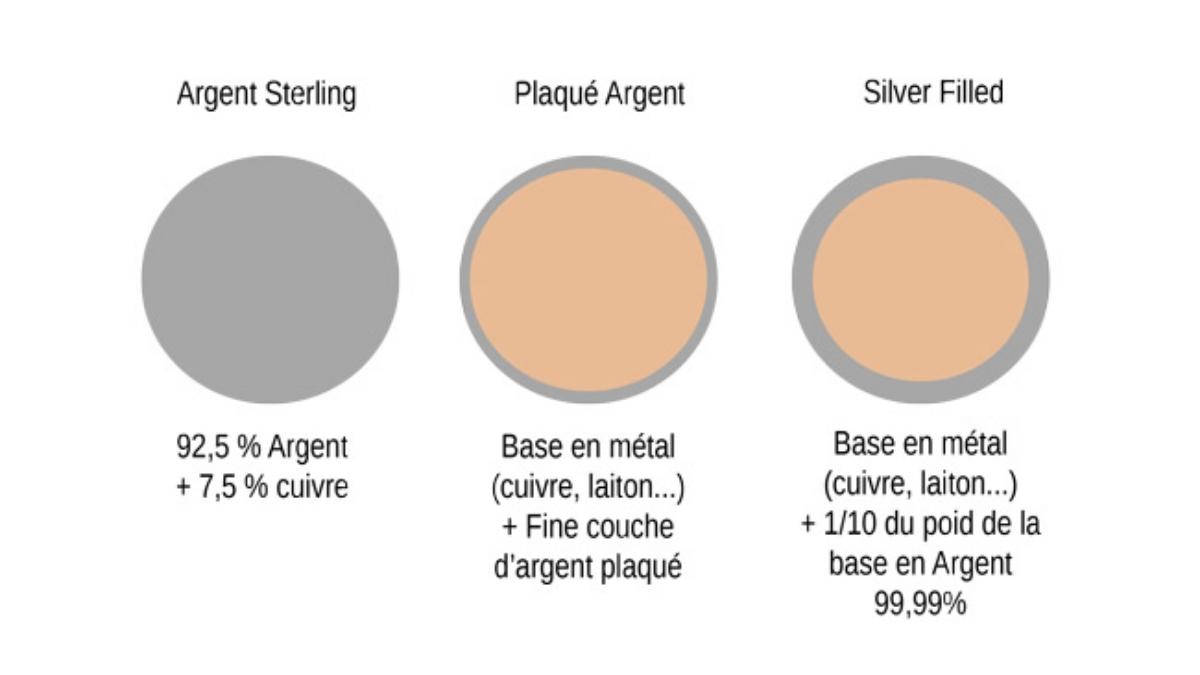
However, there are different types of silver. Sterling Silver ? Silver Filled ? Silver plated? It's hard to choose between these different denominations! Here are a few things to help you find out.
Known as fine silver, it's 99.9% pure silver. It's a very soft metal, used very little, if at all, in jewelry. It is mostly found in ingot or coin form.
It can be recognized by its amphora-shaped hallmark.
It is composed of 95% pure silver and 5% other metals such as copper. Its pure silver content makes it malleable and easy to work with to create silver jewelry. It is also resistant to corrosion, scratching and discoloration.
Sterling Silver is the other name for 925 silver. It contains 92.5% pure silver and 7.5% metals such as copper, zinc... This alloy strengthens the metal, making it easier to work. It can be gilded with 24K gold.
This is the silver most commonly used to make jewelry. In fact, if you're looking for ideas on how to make 925 Sterling Silver jewelry, take a look at our tutorials.
925 Sterling Silver jewelry must bear the Tête de Minerve 1er titre guarantee hallmark, as well as a master hallmark or responsibility hallmark (according to French legislation). It may also bear the 925 hallmark.
It can oxidize in contact with iodine from the sea, chlorine from swimming pool water, humidity, cosmetics, perspiration or household products. But it's easy to restore the shine of silver jewelry. Find out more about our tips for maintaining and cleaning your silver jewelry.


It must be at least 80% pure silver (in compliance with French legislation). The remaining 20% is usually copper.
Below 80% pure silver, jewelry is no longer considered silver under French regulations.
Solid silver jewelry must bear the Tête de Minerve 2nd title hallmark, as well as a master or responsibility hallmark.
This is a manufacturing process for jewelry components, developed in the United States, which consists of applying a layer of pure silver, either mechanically pressed or hot-applied, to a brass or copper base. It's the same process as for Gold Filled, but with 999 silver foil.
The silver corresponds to 1/10 of the product's total weight, i.e. around 100 times more than in a silver-plated product.
This brass or copper base can be in wire or plate form. The components are then manufactured cold.
It is therefore not possible to have Silver Filled components requiring metal casting and the use of molds.


This is an alloy of base metals, usually brass, coated with a thin layer of electroplated silver. It's the same process as gold plating, but with pure silver.
French legislation requires a minimum 10-micron thick layer of plating to qualify for the name Plaqué Argent.


Placage Argent should not be confused with Plaqué Argent, even if the galvanizing process is identical. However, while Plaqué Argent must comply with French legislation, as we saw earlier, Placage Argent can be coated with just a 0.03 micron flash.
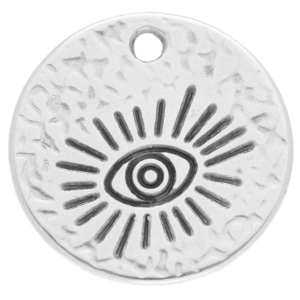
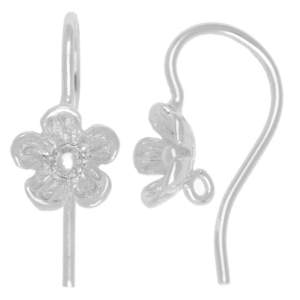

| Type of silver | Composition | Details: | Hallmark |
| 999 silver or fine silver | 99.9% pure silver | It is rarely used in jewelry because it is too soft to work and scratches too easily. | Amphora hallmark |
| 950 silver | 95% pure silver + 5% other metals | More expensive than 925 Sterling Silver. It contains more pure silver, so it is softer and more malleable, but it is also more resistant to corrosion. | Minerva head hallmark 1st grade |
| 925 Sterling Silver | 92.5% pure silver + 7.5% other metals | It is resistant and easy to work, making it the most commonly used silver in jewelry. | Minerva head hallmark 1st grade |
| Silver 800 | 80% pure silver + 20% other metals | Less expensive than 925 Sterling Silver, but more difficult to work. It is also more sensitive to scratches and discoloration, and patinas more quickly. | Hallmark Tête de Minerve 2nd Title |
| Silver Filled | Brass or copper base, covered with 999 silver leaf corresponding to 1/10 of the product's total weight. | Good alternative to 925 Sterling Silver. More resistant and durable than silver plating. | No hallmark |
| Silver-plated | Brass or copper base, coated with a minimum 10-micron layer of silver. | A good alternative to 925 Sterling Silver, it has a similar appearance, but is less resistant. | No hallmarking |
| Silver plating | Brass or copper base, coated with a thin layer of silver. | Less expensive and less durable. The silver layer can be extremely thin (0.03 micron). | No punch |



Credits
Perles & Co, Internet & E-Commerce company [08/11/2025] Any reproduction, representation, adaptation, in any form whatsoever, even partial, is prohibited, except for reproduction for private use not intended for collective use, representation in the family circle (art. L 122-5 CPI) and online publishing on condition that the source is mentioned and a link is included to the corresponding page of our site www.perlesandco.com.